One plus one equals three
How & why AION merged with another start-up

About a year ago now, I did something that not a lot of other start-up founders do, especially not at the pre-seed stage. I merged with another start-up founder. This blog exists namely to tell that story to add to what is now our company’s canon. But also because I think how this came to be highlights some important lessons that other early stage founders can learn from.
Some of those lessons are general, like acknowledging where your strengths and weaknesses are, and some are a bit more nuanced like how to make conversations that some people would find to be very challenging: easy.
Some examples of the types of conversations we had to engage in when executing this were, most importantly, how we wanted this to look between the two of us, but also how we then went and communicated that to our 9 other investors at the time so that we’d have their buy-in.
One that we spoke to said it for us: this merger is a 1+1 equals 3 decision.
On to it.
A New Yorker from Texas moves to St. Louis
In a prior post, I wrote about my first phone call with RJ. A mutual friend who became a mutual investor had put us in touch because he knew that we were both thinking about the same ideas, although with myself focused on applying biophysical interventions to solving for more effective cell reprogramming outcomes and RJ for developing cancer therapeutics.
Even then we were aligned on a common fundamental motivation: bringing the aging process under biomedical control.
After that phone call, we didn’t talk again until we’d both made it through our pre-seed rounds. The same investor who put us in touch for that initial phone call put us back in touch over the summer because after RJ raised his first round, he needed a place to execute on his company, and that was something that I’d already figured out here in St. Louis. Our mutual friend/investor--who I’ll refer to from here on out as simply Justin--knew from another blog I wrote that I was welcoming other researchers to join me in my lab in St. Louis because first, I wanted to build a community of likeminded individuals and second, that this offer solved a common bottleneck for early stage biotech founders.
That bottleneck is that whether you’re starting with a $10k grant or a 7-figure seed, if you don’t have the space and equipment to explore your ideas, you can’t get off the ground. Beyond even this, the equipment needed to get off the ground often comes with a minimum of five to six figures in costs for equipment that might only see a couple of hours of use per day while experiments are being run.
So in RJ’s case, a fully equipped lab--or at least a lab equipped enough to run proof of concept experiments--was a huge value proposition, one that was worth moving to St. Louis from upstate New York for. So that is exactly what he did, and shortly after this is where our friendship, but not yet our partnership, had begun.
Sharing more than equipment
As I’ve told over time here, I have essentially no formal training in biology, much less biophysics and engineering, the intersection of which is the set of knowledge required in order to make our work successful.
For a brief refresh/intro for newcomers: I deferred undergrad to start a company that was eventually wound down and sold when COVID killed our core revenue stream. From here I got involved doing consulting for a regional bank among other groups and eventually joined an existing podcast as a producer, which both led to me starting another company with my friend and host, Vance Crowe, and coming across Michael Levin’s work for the first time. I was enamored. This was the coolest work being done in all of biology that no one else seemed to have heard of yet. That was close to 5 years ago now. Vance encouraged me to treat this partnership like grad school: “Use this podcast to talk to anyone you want in the world and learn the things you need to in order to pursue your life’s work.” Well, I did. And so after some things I’d written in this space on the side started to take off, getting me invited to conferences to speak and eventually leading my first investors to find me, Vance bought me out of the business we’d started, Legacy Interviews, and I was on my way with AION.
All this to say--in this time I’d developed a depth of experience in how to function professionally in the world of business while having only just started to cut my teeth in biology and was now diving in full time to figure it out.
Meanwhile, here’s my skyhook of RJ.
RJ originally went to Texas A&M to study nuclear engineering. After 2 semesters he switched because for one, he felt there were more open regulatory problems in that domain than scientific ones, and having gotten into biohacking, his attention was eventually captured by the largest problem known to man: how to solve human aging. Because of this he switched to biochemistry, all the while building a massive following online posting about his experiences trying new things--often on himself--and what he was learning combing through papers across the field. After his undergrad, RJ went to upstate New York to pursue a PhD in biophysics, where he was studying liquid-liquid phase separations inside of cells. When his first opportunity for investment came in, he had no sunk cost fallacy and dropped out preceding his move to St. Louis.
This to say, RJ’s ability to comb through massive amounts of scientific context and resurface with a deep understanding of what he’d reviewed and use that understanding to make actionable experimental decisions was way, way in advance of mine at the time. So much so that as we were working on our companies side-by-side every day, he would often help me make decisions about how to design and run experiments to answer my own questions.
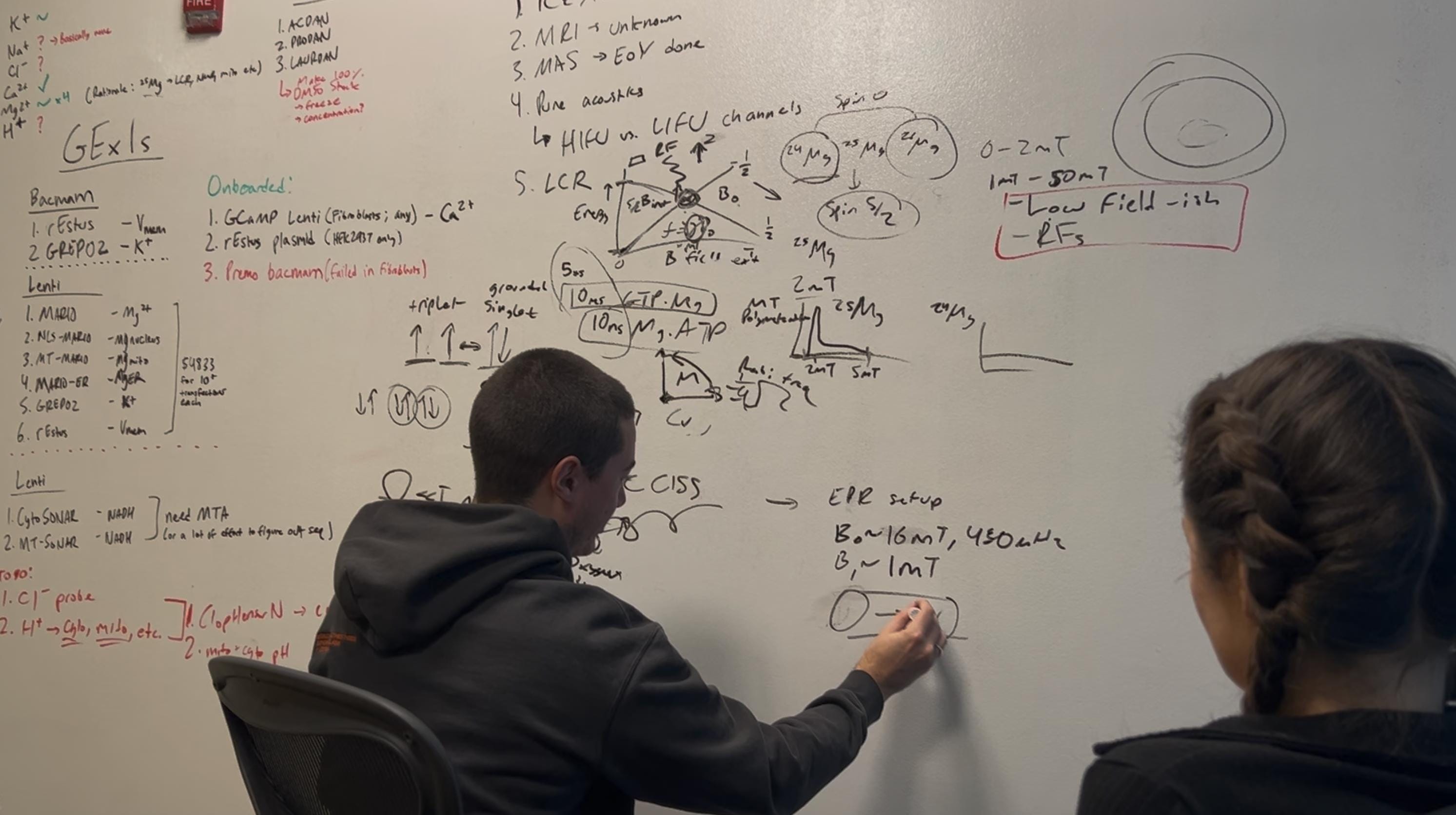
The exchange went both ways. RJ might kick me for writing this, but sometimes he would come out of the call booth at the lab and jokingly say he had to go home and take a nap because the investor or regulatory call he’d just gotten off of was so taxing. So we would also have conversations about how to approach these types of conversations and tell stories that help people with less context understand and develop buy-in for your own complex ideas--something I’m a little good at, at risk of standing on a soapbox.
So here was our first clear alignment vector: our skills are very complementary.
The second came a few months later as we’d converged on a common modality that became the obvious solution to the work that each of us was developing.
Going all in on fields
At the start, RJ and I were both exploring paths to characterize the ways that the biophysical state of cells changes during processes that are typically targeted with molecular interventions, so that we might elucidate a more effective strategy to target those same processes with a molecular intervention based on that biophysical state change.
Take the cell reprogramming example to make this tangible. The flow was: add a bioelectric reporter to a skin cell, do cell reprogramming on that cell the way everyone else does now--with Yamanaka factors and chemicals--watch how the biophysics changes during this process, then use that characterized pattern of change to inform a more effective reprogramming strategy.
In RJ’s case he was doing something very similar except by characterizing the changes of water structure inside of cancerous tissue vs. healthy tissue, a relationship substantiated by the fact that over 50 years ago it was directly what led to the development of the MRI.
Here we reached a common problem: now we were ready to test novel compounds based on our characterizations, but the relationships between existing drugs and the state changes we were targeting aren’t well enough established that we could go off of present information without doing our own internal screens against candidates.
My default plan was to use something like Levin’s Electroceutical Design Environment database. However, as we wrote in a past post:
After identifying the basic bioelectric reprogramming signature tied to cell reprogramming, we started thinking about how to impose it on all cells in our experiments for higher efficiency. Problem was that the information we had to go off of was (X) chemical acts on (Y) mechanism to change membrane potential in a positive or negative direction. That said, the level of fidelity of information we required for our work to continue was: (A) concentration of (X) chemical in (B) cell type leads to (C) degree of change (e.g., 5mV, 20mV, 50mV) over (T) time, which would require a non-trivial amount of chemical screening and moreover developing a microfluidic system for dynamically updating concentrations in cell media, a strategy that would not translate to in vivo application.
And on the other side of this, we would still not have solved the largest looming problem to translation: spatio-temporal precision in effect. What I mean by this is the biology intervention that allows you to say “Do this here, for this long” and then change this over time in such a way to match the characterization of desired change.
In a series of joint brainstorms, it became increasingly obvious to RJ and me that the best way forward was to go all in on fields as a modality. And moreover, it became increasingly obvious that the best way to do this was together.
Now we just had to figure out how to execute that decision.
Becoming one AION
Two companies with 9 different investors and 3 employees that want to become one. How ought we to think about going about this? What will our investors think? How do we establish valuations for a merger?
These are the questions we were asking ourselves after this decision became clear.
It did not take us long to determine we wanted to do an essentially equal value merger. By this point, we’d both gotten familiar with a school of thought my old partner Vance calls ‘interest-based communication’ and used these skills to talk about what we wanted our new partnership to look like. After this was executed, Vance produced a short video telling this story to serve as a testimony for his class. You can check that out below.
This was only complicated by the fact that despite viewing each other as equals, one of us had raised about 6x the other, so I had to figure out how to go to my investors and explain who RJ was in a way that made what looks on paper like dilution--a win.
This was made a little bit easier by the fact of the matter that a subset of my investors were also RJ’s investors--a testament to the taste held by 1517, Long Journey Ventures and Ambush Capital!
So, we decided to approach our mutual friend Justin and express the desire to pull this trigger and get his advice on how.
His advice was simple: be direct, communicate this is the best path forward with receipts for why, and make the first move at defining what it ought to look like so that we are starting conversations from our own definition for the best version of our future.
So, that is exactly what we did.
We defined an equal value merger with AION as the surviving entity and all past and future work to be held under one roof.
That decision was executed about 10 months ago at the time of writing. It will be looked back on as the single highest-leverage decision we’ll ever make on behalf of the company.
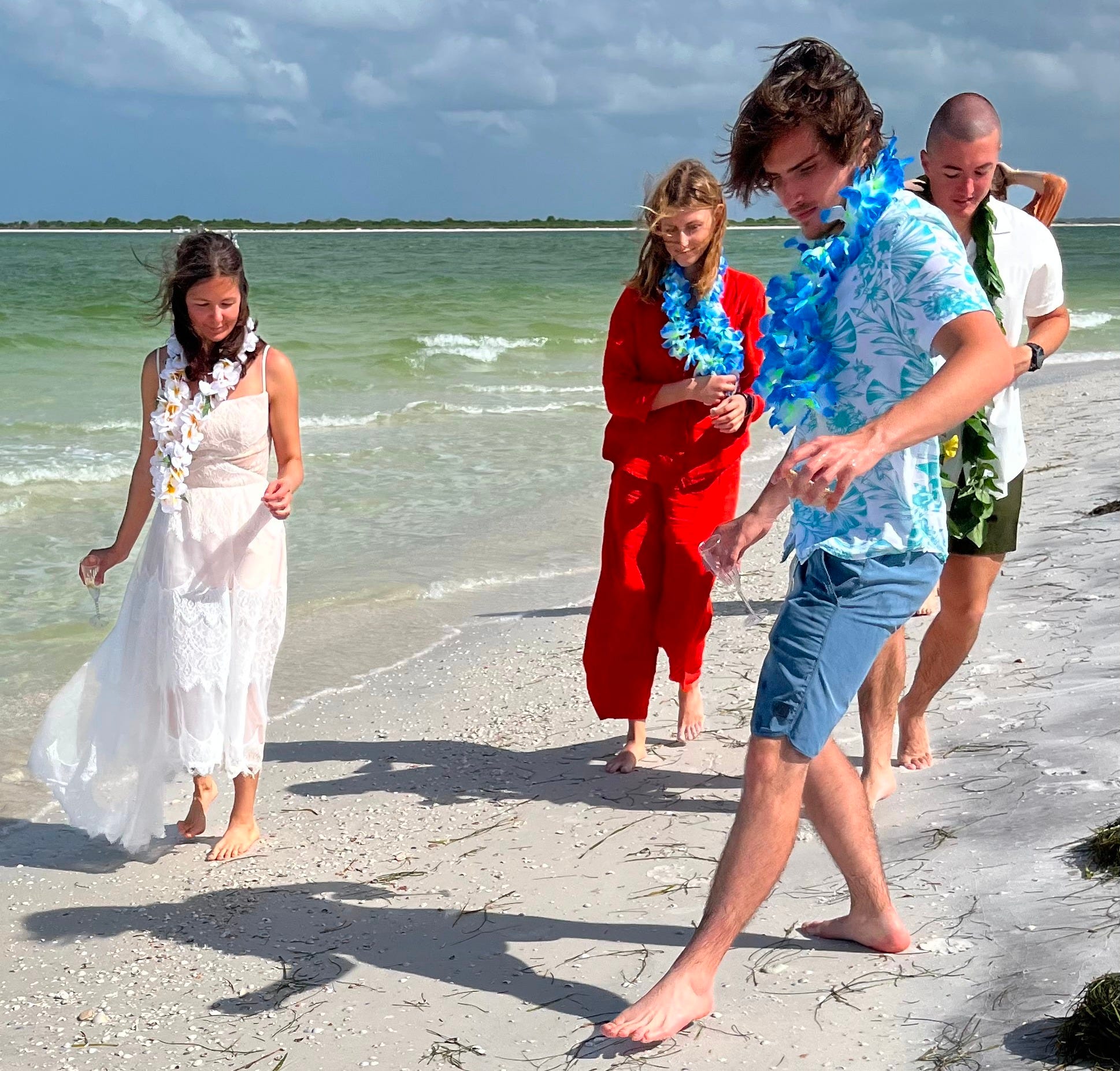
RJ and I joke now that between the two of us we got married 3 times last year. RJ to his wife Ellie, me to my now wife, Olga, and then to each other.
To close with an earnest plug: we’re actively hiring for engineering positions. If you want to be the next to join our family, apply at aion.bio.
‘Til next time.
-Benjamin Anderson